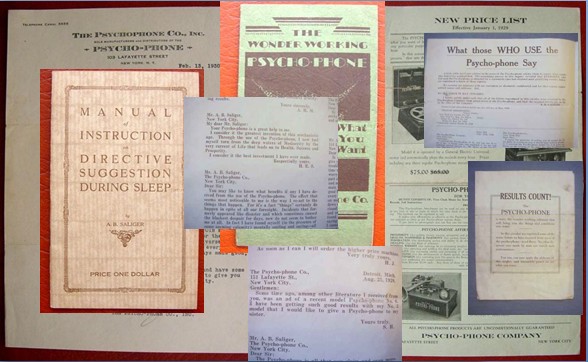
I worked directly with Vicki Childress regarding her psycho-phone device. If you look below you will see the information that she saw. You will noticed the inventor and what involvement Thomas Edison had in inventing "a device" are 2 separate questions left open ended. We are happy that History Detectives came to the same conclusion as you see in detail below regarding the purpose of her device. Please also see our Edison White Paper for more information on AB Saliger (the inventor) of Vicki's psycho-phone and our research on Edison.
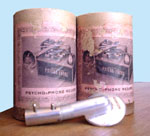
Since this information is now public we thought you might enjoy these pictures from our research. Please click on the graphic to go to the full size copies. and please check out our Edison White Paper
Villa Montezuma's Jesse Shepard (aka Francis Grierson) and Psycho-Phone Messages
If Thomas Edison died before completing the project who invented this device or completed Thomas Edison's work? Is that why there is no patent or trademark on record? Is it also why there only seems to be 2 of these devices known to exist? Update: The device shown below comes from the Psycho-Phone Company in New York, NY. The inventor is AG Saliger. Any device that Thomas Edison was working on still requires further investigation.
Did Thomas Edison and Jesse Shepard ever meet? Did Jesse Shepard (Francis Grierson) write a book about this device or is it unrelated? I decided to ask Jesse Shepard what he knows about the psycho-phone. Here is what he had to say.
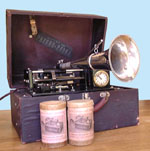  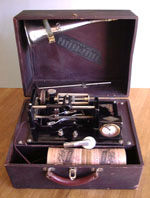
The Encyclopedia of Occultism and Parapsychology (3rd ed.) lists a "psychophone" as a "direct voice communication at a séance." In 1921 Jesse Shepard (aka Francis Grierson) published Psycho-Phone Messages -- purporting spiritual communications from the likes of U. S. Grant, Thomas Jefferson, Benjamin Disraeli, and so forth. "The psycho-phonic waves, by which the messages are imparted, are as definite as those received by wireless methods." This machine was found in a decaying mansion in Attalla, Alabama, in 1997.
  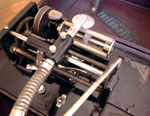
This is one of only two Psycho-Phone cylinder phonographs known to exist. It's the actual machine pictured on page 221 of Tim Fabrizio's and George Paul's "Discovering Antique Phonographs" (Schiffer, 2000). Here's a little of what we know, quoting liberally from Tim and George who relied on the good research of Psycho-Expert Doug DeFeis:
Self-improvement through subliminal suggestion was a hot topic in 1927 when the Psycho-Phone trademark was registered. The Psycho-Phone was designed to play a pre-recorded message to its slumbering user during the night. The self-improver would pre-record a message on the wax cylinder... something like "I am a success. I am rich. Men seek my wisdom. Women seek me." Or more basic suggestions, such as "In the morning I will wake refreshed -- invigorated -- and enjoy a regular bowel movement."
He would set the wind-up alarm clock for a specific time, and mid-slumber his words would be spoken directly into his subconscious -- that is, if the whirring of the electric motor and clanking of the machinery didn't wake him first. After the cylinder played through, a return mechanism reset the machine for the next night and shut the whole thing down.
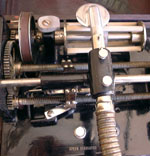
Fabrizio and Paul observe: "Like the cylinder talking machines of the early 1890s, the Psycho-Phone was an acoustic machine driven by an electric motor -- surely the last of its kind for home use." Yet questions remain -- the mandrel, for instance -- was it simply cheaper to use four rubber-coated rods, or was this a cunning way of circumventing the tapered-mandrel patent?
This is a heavy-duty, clever, and unique machine built by a skilled machinist. The two wax cylinders sold with it are broken and unplayable (they are in the boxes pictured below, not above). From all appearances they are actually readily-available Dictaphone cylinders cut to the length of a standard record. (Presumably the next owner could cut his own Psycho-cylinders and give it a try.) The original recorder survives with this machine; the original reproducer is lost, but any floating Columbia reproducer ought to do. Note the clock is in need of repair.
04/20/03 Update. This was taken from WorldITC.org. The mystery still remains:
In the 1920s, Thomas Alva Edison, inventor of the electric light, the motion picture camera, and phonograph, was busily at work in his laboratory building a machine to achieve spirit communication with the dead. His assistant, Dr Miller Hutchinson, wrote, “Edison and I are convinced that in the fields of psychic research will yet be discovered facts that will prove of greater significance to the thinking of the human race than all the inventions we have ever made in the field of electricity.”
Edison himself wrote, “If our personality survives, then it is strictly logical or scientific to assume that it retains memory, intellect, other faculties, and knowledge that we acquire on this Earth. Therefore … if we can evolve an instrument so delicate as to be affected by our personality as it survives in the next life, such an instrument, when made available, ought to record something.”
Unfortunately, Edison died before he could complete his invention. Yet, as he lay dying, he remarked to his physician, "It is very beautiful over there." Edison was a scientist, very factual, and as a scientist would never have reported "It is very beautiful over there," unless he believed it to be true.
03/10/03 Update. I have been in communication with a couple who just won a Psycho-phone device at an auction. They are already experiencing electrical disturbances in their home. Click here to read about their experiences.
Today some people still use subliminal suggestions for self-improvement. Legal professionals, such as a Boy Scouts abuse lawyer, can use subliminal messages to focus their minds to prepare for a tough court case.
|